
The Context and the Strategic Challenge
The National Healthcare Institute (NHI) is dedicated to elevating the standard of patient care through continuous medical education and innovation. In 2010, the NHI identified a critical friction point in clinical environments: the manual and often imprecise tracking of localized patient symptoms. They required a digital tool that could modernize this workflow for nurses and allied health professionals.
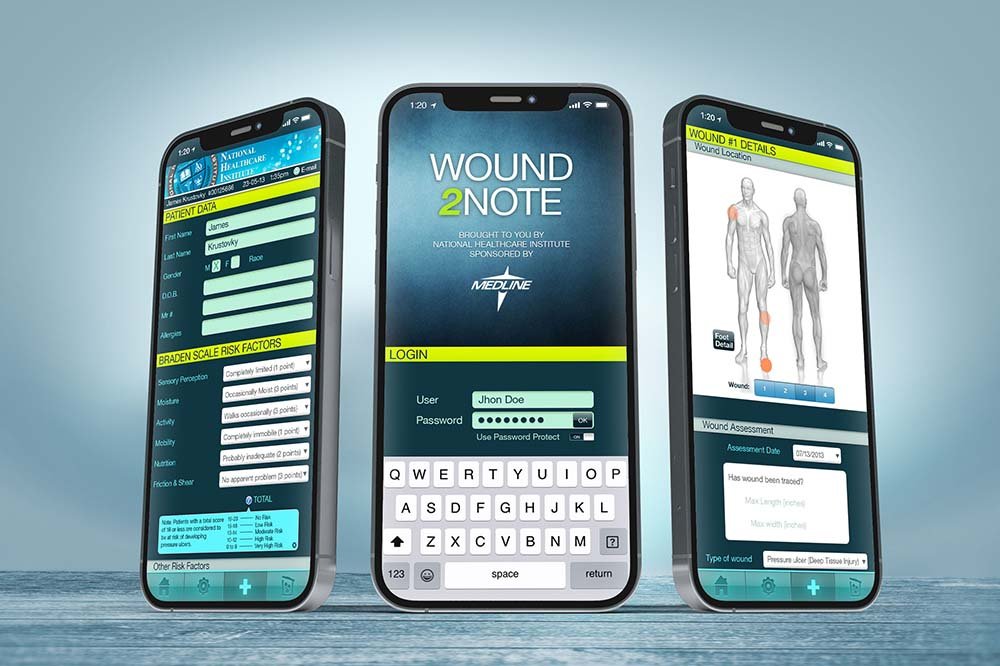
The strategic challenge was "Clinical Efficiency." We needed to design an iOS application that allowed medical staff to record, manage, and retrieve symptom histories with zero learning curve. The interface had to operate flawlessly in fast-paced medical scenarios where cognitive load is high, meaning complex data entry had to be replaced with visual, intuitive interactions.
Strategic Deliverables
- → iOS App UI/UX Architecture
- → Clinical Workflow Optimization
- → Spatial Symptom Mapping (Body UI)
- → Medical Brand Identity Translation
- → High-Contrast Interface Design
- → Web-Based Instructional Platform
Spatial Mapping and Clinical UX
To bypass tedious text entry, I engineered the core UX around an interactive human body map. This spatial approach allowed healthcare professionals to pinpoint the exact location of a wound or discomfort with a single tap, dramatically increasing both the speed and accuracy of medical records. To support this functionality, the color palette was strategically defined: deep clinical blues to project calm and trust, contrasted sharply with neon green accents to guide the user’s eye instantly to primary calls-to-action.
Beyond the native iOS app, I developed a synchronized web platform that served as an onboarding and instructional hub for the software. By ensuring that the visual language and user journey were seamless across both the mobile and web touchpoints, we accelerated user adoption among medical staff and minimized the technical barrier to entry.
The Result: Empowering Patient Care
The Wound 2 Note application successfully bridged the gap between technological innovation and practical clinical application. By delivering a highly intuitive, visually driven tool, the NHI was able to provide healthcare professionals with a reliable method to manage medical histories efficiently. This project stands as a testament to the power of specialized UI/UX design in MedTech, directly contributing to improved healthcare outcomes and superior patient care.